Introduction
A Level 7 Diploma can be a flexible route for students and working professionals who want to progress towards a Master’s degree in the UK. It allows learners to study at Master’s level first, then explore dissertation or top-up routes where available and subject to university entry requirements.
For many students and working professionals, a full Master’s degree is an important goal — but committing to a traditional full-time programme from the beginning is not always practical.
This route can be particularly attractive for working professionals, international students, and learners who want to manage their study, cost, and career commitments step by step.
What is a Level 7 Diploma?
A Level 7 Diploma is a postgraduate-level qualification. In the UK education framework, Level 7 is the same academic level as Master’s study.
This does not mean that a Level 7 Diploma is the same as a full Master’s degree. A full Master’s degree usually includes a dissertation, research project, or applied project in addition to taught modules.
A Level 7 Diploma normally focuses on advanced taught study in a specialist area such as:
- Strategic Management and Leadership
- Human Resource Management
- Strategic Marketing
- Artificial Intelligence
For students who want advanced knowledge without immediately committing to a full Master’s programme, a Level 7 Diploma can be a useful first stage.
How can a Level 7 Diploma lead to a Master’s degree?
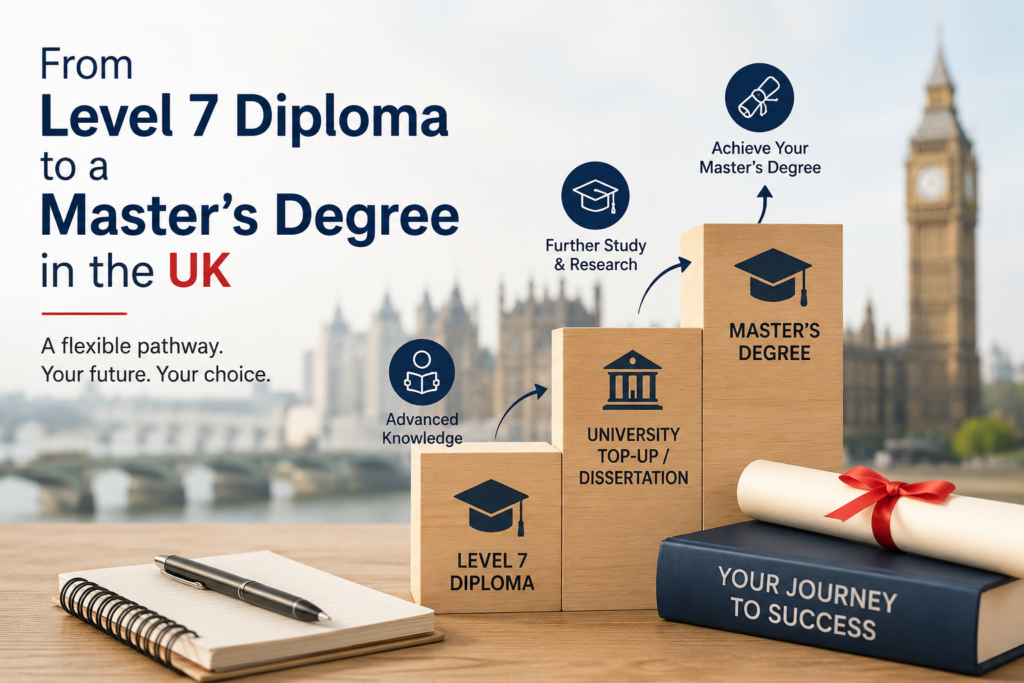
A common progression model is:
Stage 1: Complete a Level 7 Diploma
You study advanced postgraduate modules and build specialist knowledge in your chosen area.
Stage 2: Progress to a university top-up stage
Where available and subject to entry requirements, you may progress to a university to complete a dissertation, research project, or applied project.
Stage 3: Achieve a full Master’s degree
After successfully completing the university stage, you may be awarded a full Master’s degree by the university.
In simple terms, the Level 7 Diploma can act as a taught postgraduate stage, while the university top-up or dissertation stage completes the Master’s route.
Why choose this route (level 7 diploma) instead of starting a full Master’s immediately?
A Level 7 Diploma route can offer several practical advantages.
1. More flexibility
Many Level 7 Diploma programmes are designed for people who are working or managing other commitments. Online and blended study options can make postgraduate education more accessible.
This is especially useful for professionals who want to continue working while studying.
2. A staged financial commitment
Rather than paying for a full Master’s programme upfront, students may be able to begin with a Level 7 Diploma and then decide whether to progress to the university top-up stage later.
This can help learners manage their investment in education more carefully.
3. Career-focused learning
Level 7 Diplomas are often designed around practical, applied knowledge. For example, students may study leadership, strategy, marketing, HR, AI, or management topics that can be applied directly in the workplace.
This makes the route attractive for professionals seeking promotion, career change, or specialist knowledge.
4. A pathway to further study
For students who want a full Master’s degree, the Level 7 Diploma may support progression to a university top-up route, subject to the requirements of the receiving university.
This gives learners a structured way to begin postgraduate study and keep future progression options open.
Who is a Level 7 Diploma to Master’s route suitable for?
This route may be suitable for:
- working professionals who want to study while remaining employed;
- managers preparing for senior leadership roles;
- HR, marketing, business, AI, or strategy professionals seeking specialist knowledge;
- international students looking for a flexible UK-style postgraduate pathway;
- learners who want to reduce initial financial risk before committing to a full Master’s route;
- students who prefer a staged approach to postgraduate education.
It may be less suitable for students who specifically want a traditional full-time campus-based Master’s experience from the beginning.
What should students check before applying?
Before choosing a Level 7 Diploma, students should ask several important questions.
Is the qualification recognised?
Check the awarding body, qualification title, level, and recognition status.
What progression routes are available?
Ask whether the qualification may support progression to a university top-up or dissertation stage, and what conditions apply.
Is progression guaranteed?
In most cases, progression is not automatic. It usually depends on academic performance, entry requirements, available routes, and university-specific criteria.
What is included in the fee?
Check whether the fee covers only the Level 7 Diploma or whether any university top-up stage is charged separately.
How is the programme delivered?
Understand whether the programme is online, blended, live, recorded, self-paced, or delivered through intensive sessions.
What support is available?
Look for academic support, feedback, study guidance, career support, and progression advice.
Important note on progression
Students should be careful with any provider that promises guaranteed admission to a university or guaranteed Master’s completion.
Progression to a Master’s top-up or dissertation stage is normally subject to:
- successful completion of the Level 7 Diploma;
- academic performance;
- university entry requirements;
- English language requirements, where applicable;
- availability of a relevant top-up route;
- university-specific criteria.
A good provider should explain both the opportunity and the conditions clearly.
How ICM supports postgraduate progression
The Institute of Customer Management offers flexible postgraduate Level 7 programmes designed for learners who want advanced, career-focused education with progression opportunities.
ICM’s postgraduate areas include:
The programmes are designed to support advanced learning, practical application, and future progression planning. Students benefit from flexible study options, applied learning, academic support, and guidance on possible progression routes.
Where applicable, students may explore university progression opportunities after completing their Level 7 programme, subject to entry requirements, academic performance, and university-specific criteria.
Level 7 Diploma to Master’s: quick summary
| Question | Answer |
|---|---|
| Is a Level 7 Diploma postgraduate level? | Yes, Level 7 is Master’s-level study. |
| Is it the same as a full Master’s degree? | No. A full Master’s usually includes a dissertation or final project. |
| Can it lead to a Master’s degree? | It may support progression to a university top-up or dissertation stage, subject to requirements. |
| Is progression automatic? | No. Progression depends on academic performance, entry requirements, and university criteria. |
| Who is it suitable for? | Working professionals, international students, managers, and learners seeking flexible postgraduate study. |
| Can I study online? | Many Level 7 programmes offer online or blended options, depending on the provider. |
Final thoughts
A Level 7 Diploma can be a practical and flexible way to begin postgraduate study. For many learners, it offers the opportunity to build advanced knowledge, continue working, manage costs, and keep open the possibility of progressing towards a full Master’s degree.
The key is to choose a programme that is clear about its academic level, delivery format, fees, support, and progression conditions.
For students seeking a flexible route into postgraduate business, management, AI, HR, marketing, or leadership study, a Level 7 Diploma can be a strong first step.
Interested?
Interested in a flexible postgraduate pathway?
Explore ICM’s Level 7 programmes or speak to our admissions team to discuss your study goals, entry requirements, fees, and progression options.